
AI & Ministry
Is It Plagiarism to Use AI in a Sermon? The Real Question
Using AI in a sermon is usually not plagiarism in the strict sense, because plagiarism means passing off another person's words or ideas as your own, and AI text usually has no single author you are taking from. That does not settle the question. The better test is an old one: are you preaching without deception?
The church was arguing about borrowed sermons long before anyone typed a prompt. The working answer it reached was closer to "no pretending" than "only original words."
What counts as plagiarism in a sermon?
Sermon plagiarism is presenting someone else's words or ideas as your own work. Most pastors borrow every week and nobody calls it plagiarism. You quote a hymn and name it. You repeat an illustration and say where you heard it. A professor's insight from twenty years ago has long since become part of how you read Romans.
Trouble starts when borrowing comes with a false impression. Say a pastor preaches another preacher's sermon nearly word for word, and someone in the pews recognizes it. The content may have been fine. What hurts is that the church thought it was hearing its own pastor's study, and it was hearing someone else's.
So in practice, the line has been about the gap between what happened and what the congregation was allowed to assume happened.
Have pastors always preached other people's sermons?
Yes, and the church has said so openly. Augustine addressed it in Book 4 of On Christian Doctrine. In the common public-domain English translation, he writes: "There are, indeed, some men who have a good delivery, but cannot compose anything to deliver. Now, if such men take what has been written with wisdom and eloquence by others, and commit it to memory, and deliver it to the people, they cannot be blamed, supposing them to do it without deception."
Look at the condition at the end. Augustine was relaxed about where the words came from. He cared a great deal about deception.
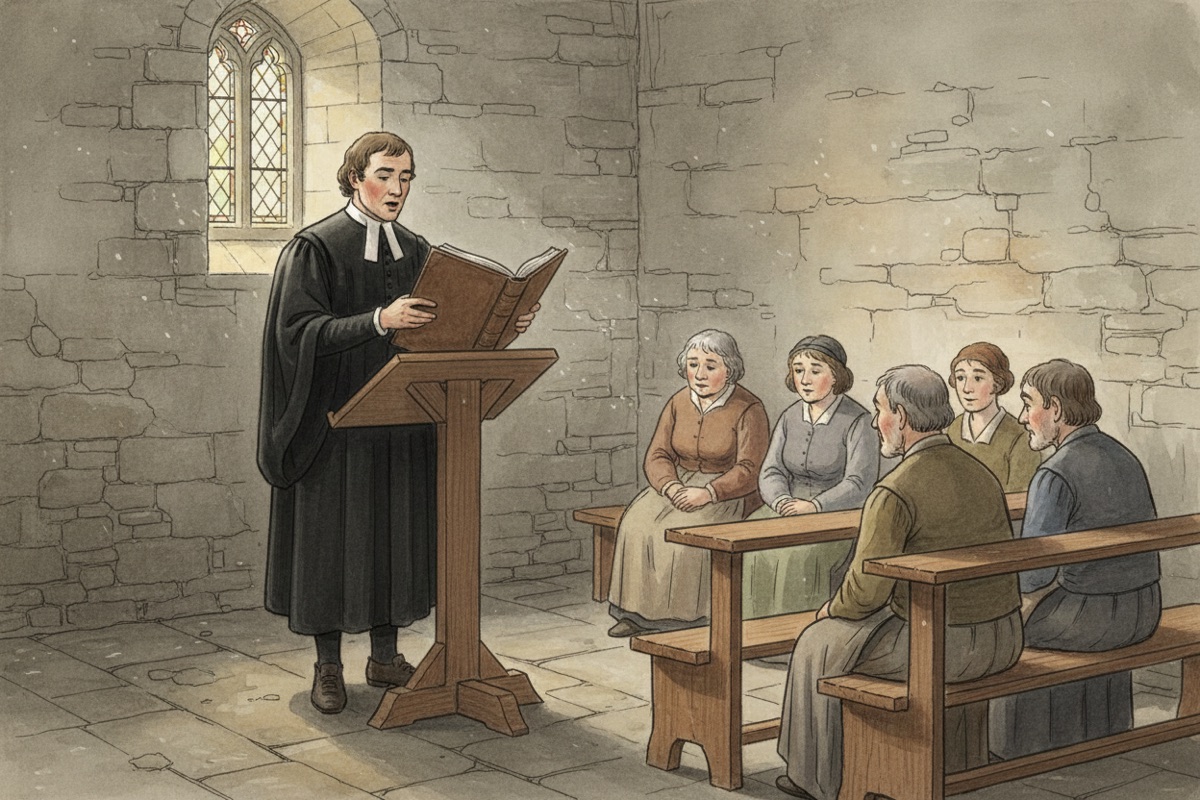
The English Reformation went further. In 1547 the Church of England issued a book of official sermons, the Book of Homilies, and parish clergy were ordered to read through them Sunday by Sunday, except when a sermon was to be preached. Parish after parish heard sermons its minister did not write. The book's own title said what it was: sermons appointed to be read every Sunday in their churches. Whatever people thought of the homilies, nobody was misled about where the words came from.
Why doesn't the plagiarism question fit AI?
Because there is usually no single author on the other end. When you lift a paragraph from another preacher, you take something from a person. When an AI tool produces a paragraph, there is often no one in particular you took it from.
Copyright law points the same way on one narrow point. In January 2025 the U.S. Copyright Office released Part 2 of its report on copyright and artificial intelligence. It concluded that material generated purely by AI from prompts is not protected by copyright, because copyright requires human authorship. Copyright is a different question from plagiarism, but it shows that "whose words are these?" often has no human answer.
There is one exception worth knowing. AI tools can sometimes echo published material closely. If a generated line sounds distinctive, search it before you use it.
So pastors ask, "Is it stealing?" and the honest answer is often, "Not from anyone in particular." Some hear that as the end of the matter. It is closer to the beginning, because Augustine's condition, "without deception," still has to be met.
What does your congregation assume when you preach?
They assume you studied the passage and that you believe what you are saying. That is the implied promise of the pulpit. Nobody expects every phrase to be original. Your people know you read books and use study tools.
What they do assume is that when you say, "I have been thinking about this all week," you have. When you tell a story as something that happened, it happened, and when you say, "Here is what this text is asking of us," that judgment passed through your own mind and conscience.
Notice what that promise does not require. It does not require you to have typed every sentence yourself. A pastor who reads a suggested paragraph, checks it against the text, rewrites what is off, and believes the result has done the work the congregation assumes. The words passed through study and conscience on the way to the pulpit.
So after you use the tool, ask one question: is the promise still true?
Where is the line in practice?
The line falls wherever the congregation's reasonable assumption stops being true. Here is how some common uses look against that test.
- Asking about background. You ask an AI tool what a Roman colony was or how a word is used elsewhere in a letter, then check it against a reliable source. This is like using a Bible dictionary. Checking matters because AI tools can state wrong things with confidence.
- Testing your outline. You ask a tool where your outline is unclear or what a listener might push back on. You keep what helps. The argument is still yours.
- Working from a suggested draft. A tool offers wording for a section. You test it against the passage, cut what you do not believe, and rewrite it until it says what you would say. What you preach has passed through your study, and the promise holds.
- Using an illustration you cannot trace. The tool offers a moving story about a farmer or a famous preacher. If you tell it as true and cannot find a source, you may be repeating something that never happened. Either say it is a made-up example or leave it out.
- Reading out paragraphs you have not worked through. You paste in text, skim it, and deliver it as your own reflection from the week. Here the gap opens. You are describing a week with the text that did not happen.
- Drafting materials after you preach. You take the sermon you already preached and use a tool to draft the recap email or the small group questions, then edit them. The content is your sermon.
Most of these keep the promise. The fifth breaks it, and the fourth does too if you tell an untraced story as true. In both cases the congregation is led to believe something false.

Should you tell your congregation you use AI?
That is your call and your church's, and pastors land in different places. A quick check helps. Imagine a member stops you after the service and asks, kindly, "How did you put this sermon together?"
If you can answer plainly, the way you would describe using a commentary or a study Bible, you are probably on solid ground. If the honest answer is one you would rather not say out loud, that discomfort is worth listening to. Augustine's phrase still works here: "without deception." Announcing every tool is optional. Being able to tell the truth about the work, if someone asks, is the part that matters.
For the practical side of this, here is a workflow for using AI in sermon prep without losing your voice.
What should you ask instead of "is it plagiarism?"
Ask what your people believe they are receiving when you stand up on Sunday. They believe the person in the pulpit opened the text, wrestled with it, and is now telling them what they found there. The plagiarism question looks backward at where words came from. This one looks at the people in front of you.
If that belief is true on Sunday, you can use, with a clear conscience, the tools that helped you get there.
Try Sermoneer
One sermon becomes a week of material: small group guide, devotional, social cards, and shorts.
Start free